I just recovered from the Fiesta Filipina event this past 6/13-6/14. On Sunday, I shared a booth with Christine of Suku Art. Here are some of the photos:


I just recovered from the Fiesta Filipina event this past 6/13-6/14. On Sunday, I shared a booth with Christine of Suku Art. Here are some of the photos:
I’ll be at the Fiesta Filipina Festival in San Francisco, CA this Saturday and Sunday 6/13-6/14.
Philippine Independence Day Celebration
Organized by Fiesta Filipina USA
CIVIC CENTER PLAZA
1 DR CARLTON B. GOODLETT PLACE
SAN FRANCISCO, CALIFORNIA
June 13 & 14, 2009 (Saturday & Sunday)
10am – 6pm
(For Driving Directions, please go to Site Layout)
(Take BART to go the Festival)
DONATION: $10.00
” Early Bird Prize Eligibility for the first 2500 attendees”
(1 MacBook and 1 iPod touch each day)
CHILDREN
(12 years old & under): FREE
Came across this event poster. The Baybayin on the left looks like it says A-LI-I – I. I assume it’s supposed to be Aliw-iw. If it is, there’s an extra I after LI. Check it out….
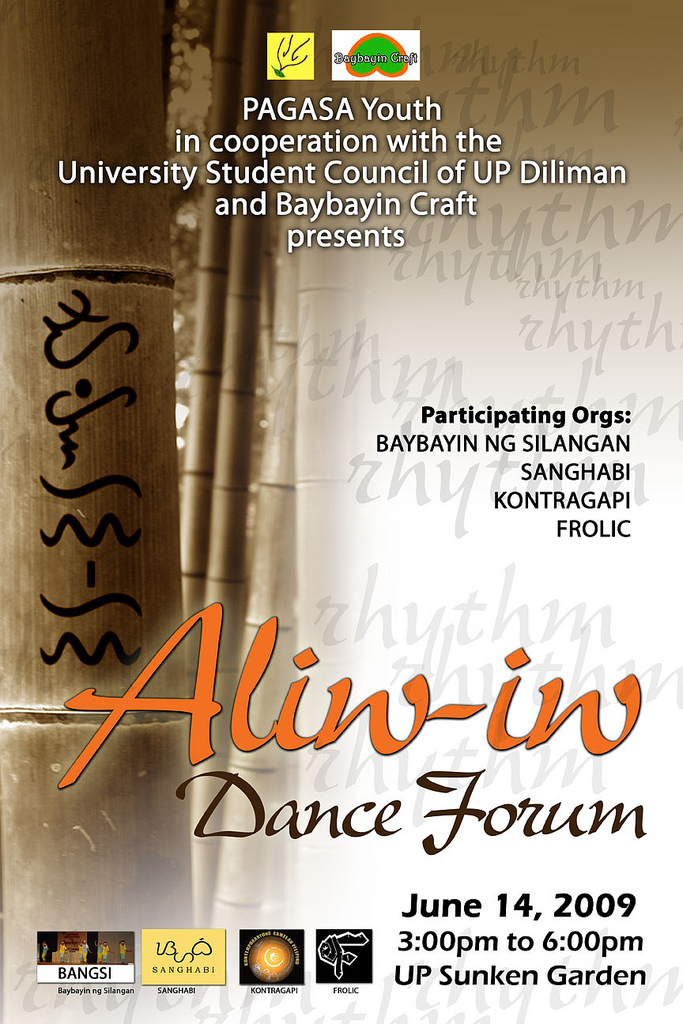

Written with graphite

I’ll be hanging out at the premier Filipino clothing store “JJ Clothing” at Great Mall, Milpitas, CA providing FREE name translations and talking Baybayin. Drop by and learn the basics of our pre-Filipino writing system. Free worksheets and other goodies.
You can also donate a pair of shoes for less fortunate kids in the Philippines at the store. Check apairforcare.com for more info. Salamat
Date:
Sunday, June 7, 2009
Time:
1:00pm – 5:00pm
JJ CLothing – Great Mall
408-586-8702
447 Great Mall dr.
Milpitas, CA 95035
The store is right across Jollibee and next to Starbucks.


Paul Morrow runs one of the most informative sites on Baybayin. Below is my interview with him.

Christian Cabuay
What got you interested in Baybayin? I assume you studied the script on your own, what was the most challenging part?
Paul Morrow
It’s a bit ironic. I became interested in Filipino/Tagalog many years ago when I discovered that Filipinos used the Roman alphabet. At the time I thought Filipinos probably wrote in Chinese or some “bizarre” script like Tibetan. That’s how little I knew. But when I happened to see a dictionary at a friend’s house, I thought, “Hey, I can read this. I think I’ll try to learn the language.” Then, a few years later, I came across an article by Lope K. Santos about the baybayin in a book for students of Tagalog. I was surprised because none of my friends had ever mentioned to me that Filipinos once had their own writing system. When I asked them I about it, they didn’t know what I was talking about. This made me very curious so I tried to find every scrap of information I could about the baybayin.
Learning the baybayin was the easy part; the challenge was finding reliable information about its history and usage. All I had in the beginning were second and third hand sources, like school textbooks. This was the dark ages before the Internet.
Art
If you follow me on Twitter (Twitter.com/Baybayin), you may have noticed that my latest work has been more digital compared to last year. That’s because I spend a lot of time on my iPhone. 1.5 hours everyday on the train, might as well do something constructive. Over the last 5 months, there have been a few apps that compliment my brush style pretty well. Detailed reviews of these apps and how I use them to come later. in the meantime, you can check out this video of Baybayin on the iPhone.
Interviews
As part of my this website, I’m featuring interviews with different Baybayin personalities. I ‘ve covered most of the known people online but, I’m facing issues finding people to interview in the Philippines. I do have an outstanding invitation for the curators of Bahay Nakpil. Does anyone have any leads?
Book
Over the last 2 years, I’ve been working on putting some sort of Baybayin book together. About 8 months ago, I finally decided on a direction. I initially wanted the book focused on history, modern modifications and art but changed my mind because I didn’t want to simply repeat what Hector Santos and Paul Morrow have already researched. The focus will now be my Baybayin art. For proper context, there will be sections on history and modern usage.
Events
I want to take part of every Filipino Festival this season but the reality is that I cannot afford to pay for the booth space for most of these events. Even if I split the costs, with my festival partner (Malaya Designs), it will still not be feasible. The problem is that this isn’t a business for me. Although I have some art prints for sale and little knickknacks, I’m lucky if I break even. I believe that Baybayin should be part of EVERY Filipino cultural event just as much as the Philippine Sun and Star shirt and condo vendors. That said, I fully understand the capitalism andwill be working on a project that will give me presence at these events without me going broke. It may not happened this festival season, maybe next year.
Coming soon….
My day job is an Web Analyst and one of my job functions is user integration and documentation. Looking at the current Baybayin educational landscape, there’s a lot of great info out there thanks to Hector and Paul but it can be overwhelming to the newbie. It takes effort to read everything and filter out the crap. With the good info, there’s also inconsistent and some nonfactual material out there. The challenge is gathering all these moving parts and putting it in a clear and concise package. One of the best ways to leqar the script is via workshops. Unfortunately, workshops are limited to physical locations. Online workshops are limited by time constraints.
This summer, I’ll be launching a Baybayin course to hopefully address those issues.

I recently finished reading Paul R. “Verzosa’s Pangbansang Titik nang Pilipinas”. He’s the man responsible for coining the term Alibata. You might have read the quote that’s been re-quoted over and over again from Paul Morrow’s site:
In 1921 I returned from the United States to give public lectures on Tagalog philology, calligraphy, and linguistics. I introduced the word alibata, which found its way into newsprints and often mentioned by many authors in their writings. I coined this word in 1914 in the New York Public Library, Manuscript Research Division, basing it on the Maguindanao (Moro) arrangement of letters of the alphabet after the Arabic: alif, ba, ta (alibata), “f” having been eliminated for euphony’s sake.”
While that quote is accurate, it doesn’t tell the whole story as to why he did it. There wasn’t any explanation why he linked the script to Arabic but there were some interesting points that may give you an idea of his motive.
He writes about the origin of the word “Alphabet” and his seemingly admiration of of other cultures who have names of their alphabet.
The Japanese call theirs the KANA and HIRAGANA SYLLABARIES invented by a Budhist mon in 700 AD which are based on the simple Chinese symbols. The Hindus call their Sandskrit alphabet DEVANGARI meaning “THE CITY OF GOD.” (Pangbansang Titik nang Pilipinas pg 11 – Paul R. Verzosa – 1939)
Maybe one of his goals to rename the script was to uplift it. He does acknowledge that the writing was indeed called Baybayin by the natives.
The first Spanish conquistadores and missionaries who came to the Philippines after the death of Magellan in the Island of Mactan found that the Tagalogs used to write their spoken speech in their native system called BAYBAYIN, and equivalent of Alphabet; but he litteral meaning of Baybayin is TO SPELL OUT or SYLLABICATE.(Pangbansang Titik nang Pilipinas pg 11 – Paul R. Verzosa – 1939)
It looks like he wasn’t content with the generic term equivalent of Alphabet. He wanted something more majestic in order to perhaps give the Filipinos a sense of pride. Putting all that aside, it still doesn’t really explain why he chose Arabic as a base of the script. He does document that Baybayin is a direct descendant of Sanskrit.
Asia adopted the various simplified and popularized Sanskrit alphabet and handwriting, of which the Tagalog handwriting is its distant but direct descendant.(Pangbansang Titik nang Pilipinas pg 17 – Paul R. Verzosa – 1939)
The book is broken down in 3 parts:
Part1: Historical Background
Part2: The Structure of the Language
Part3: How to Read and Write
At the end, there were advertisements. Check out BPI. Mapua also had one as well.


It’s summer and time to show off your tattoos and abs. Here’s some work I’ve done for hot bodies.
Kat Longa (Playboy model)
She liked the look of modified Baybayin on her back even if I tried to get her to go with traditional. How could I say no? Below is a photo of her wrist that says Ate (sister).


 Kristian Kabuay