Interview: Paul Morrow

Paul Morrow runs one of the most informative sites on Baybayin. Below is my interview with him.

Christian Cabuay
What got you interested in Baybayin? I assume you studied the script on your own, what was the most challenging part?

Paul Morrow
It’s a bit ironic. I became interested in Filipino/Tagalog many years ago when I discovered that Filipinos used the Roman alphabet. At the time I thought Filipinos probably wrote in Chinese or some “bizarre” script like Tibetan. That’s how little I knew. But when I happened to see a dictionary at a friend’s house, I thought, “Hey, I can read this. I think I’ll try to learn the language.” Then, a few years later, I came across an article by Lope K. Santos about the baybayin in a book for students of Tagalog. I was surprised because none of my friends had ever mentioned to me that Filipinos once had their own writing system. When I asked them I about it, they didn’t know what I was talking about. This made me very curious so I tried to find every scrap of information I could about the baybayin.

Learning the baybayin was the easy part; the challenge was finding reliable information about its history and usage. All I had in the beginning were second and third hand sources, like school textbooks. This was the dark ages before the Internet.

Continue reading

Paul R. Verzosa's Pangbansang Titik nang Pilipinas – How Baybayin was named Alibata

I recently finished reading Paul R. “Verzosa’s Pangbansang Titik nang Pilipinas”. He’s the man responsible for coining the term Alibata. You might have read the quote that’s been re-quoted over and over again from Paul Morrow’s site:

In 1921 I returned from the United States to give public lectures on Tagalog philology, calligraphy, and linguistics. I introduced the word alibata, which found its way into newsprints and often mentioned by many authors in their writings. I coined this word in 1914 in the New York Public Library, Manuscript Research Division, basing it on the Maguindanao (Moro) arrangement of letters of the alphabet after the Arabic: alif, ba, ta (alibata), “f” having been eliminated for euphony’s sake.”

While that quote is accurate, it doesn’t tell the whole story as to why he did it. There wasn’t any explanation why he linked the script to Arabic but there were some interesting points that may give you an idea of his motive.

He writes about the origin of the word “Alphabet” and his seemingly admiration of of other cultures who have names of their alphabet.

The Japanese call theirs the KANA and HIRAGANA SYLLABARIES invented by a Budhist mon in 700 AD which are based on the simple Chinese symbols. The Hindus call their Sandskrit alphabet DEVANGARI meaning “THE CITY OF GOD.” (Pangbansang Titik nang Pilipinas pg 11 – Paul R. Verzosa – 1939)

Maybe one of his goals to rename the script was to uplift it. He does acknowledge that the writing was indeed called Baybayin by the natives.

The first Spanish conquistadores and missionaries who came to the Philippines after the death of Magellan in the Island of Mactan found that the Tagalogs used to write their spoken speech in their native system called BAYBAYIN, and equivalent of Alphabet; but he litteral meaning of Baybayin is TO SPELL OUT or SYLLABICATE.(Pangbansang Titik nang Pilipinas pg 11 – Paul R. Verzosa – 1939)

It looks like he wasn’t content with the generic term equivalent of Alphabet. He wanted something more majestic in order to perhaps give the Filipinos a sense of pride. Putting all that aside, it still doesn’t really explain why he chose Arabic as a base of the script. He does document that Baybayin is a direct descendant of Sanskrit.

Asia adopted the various simplified and popularized Sanskrit alphabet and handwriting, of which the Tagalog handwriting is its distant but direct descendant.(Pangbansang Titik nang Pilipinas pg 17 – Paul R. Verzosa – 1939)

The book is broken down in 3 parts:
Part1: Historical Background
Part2: The Structure of the Language
Part3: How to Read and Write

At the end, there were advertisements. Check out BPI. Mapua also had one as well.


Baybayin on hot bodies

It’s summer and time to show off your tattoos and abs.  Here’s some work I’ve done for hot bodies.

Kat Longa (Playboy model)
She liked the look of modified Baybayin on her back even if I tried to get her to go with traditional. How could I say no? Below is a photo of her wrist that says Ate (sister).

Continue reading

Malaya Designs

My partner in crime from Malaya Designs just relaunched his website.  When I just heard of the script, he was already doing his thing.

We have a booth at the 5th Annual Asian Heritage Street Celebration right in front of the Asian Art Museumn
Larkin Street near McAllister. Take Bart and get off at Civic Center

Date:
Saturday, May 16, 2009
Time:
11:00am – 6:00pm
Location:
Asian Art Museum
Street:
200 Larkin st
City/Town:
San Francisco, CA

Check out the Faceboook Event page

MalayaDesigns.net

Malaya (ma-la-ya) adj; 1 free 2 not in someone else’s power 3 not controlled or enslaved by another 4 free from the influence of others 5 free to speak one’s mind 6 a free people.

About Malaya Designs: The First and Original
A Baybayin practitioner since 1994, Malaya Designs was established in 1997 in the San Francisco Bay Area, to celebrate the richness of our heritage. The first and original company anywhere to offer; custom, handmade wearable art made of wood or bamboo. Through our art we aspire to promote, propagate, and educate in the discovery of a rich culture that is Filipino.

Interview: Suku, New Sun Artistry

suku art

Christian Cabuay
How and when did get started with Baybayin?

Christine Balza
My father was in the US AirForce, we had been stationed at Clark AFB in 1976-79 where I attended Lily Hill Jr High on the base. We studied Filipino Culture and aside from the general information we were introduced to ancient history. Including a brief description on our ancient script, Baybayin. Over the years I had glimspes of it on tattoos that family and friends proudly adorned. I carried a print out of the script and a deep curiousity of how it worked. With the internet I had been able to teach myself the basics.

Mixing Baybayin with my crafts… I made my sister a pendant for Mother’s Day(which said “Ina”)and it caught the eye of one of the tshirt vendors at a street fair and I followed my heart…

Continue reading

Movie: Green Rocking Chair. A Juan Baybayin Story

green-rocking-chair

Came across this documentary today. I badly want to see this. Too bad it’s not on DVD yet. It was released 2008 in the Philippines and directed by Roxlee.

The filmmaker’s personal search for Baybayin or Alibata, the original Filipino writings before the Spaniards came and colonized the Philippines in 1521. The search will determine of such ancient alphabet still exists and practices all over the archipelago.

GreenRockingChairMovie.com
IMDB info

Baybayin brush font

For a limited time, download my brush style Baybayin font for FREE. If you ever used Paul Morrow’s fonts, they work the same way. I haven’t create documentation yet but you can get some basic info by downloading one of the files from Paul Morrow. For personal use only. Check out myfonts.com to learn how to install. Contact me with any questions. 

Get it at my.Baybayin.com

Interview: Philippine Script Designs

philippine-script00

Christian Cabuay
How did you get into baybayin and when?

Michelle Ruschman
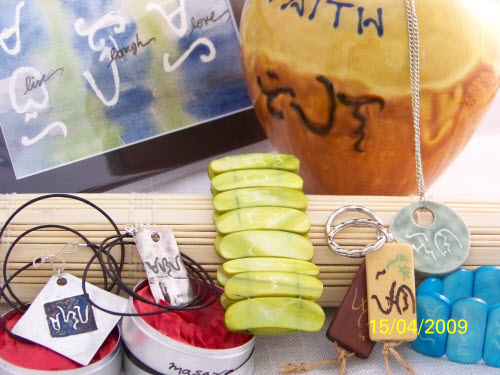
In 2007 I was on the internet looking for jewelry celebrating the Philippine culture and came across it then. I instantly fell in love with it and it really became a PASSION to learn it and express it.

My mom and I immigrated from Cebu when I was two. With my mom believing in immersion (learning English to help me in school and embracing our adopted culture) and my American dad (who adopted me), I became more American than Filipino in how I expressed who I was. My dad eventually joined the air force and during an active duty assignment we were stationed at Clark Air Base in the Philippines. It was during this time the ousting of Marcos was going on so we got to witness the revolution first-hand. As a young Filipina who was really being introduced to her culture for the first time, it changed how I would see myself forever. Watching my countrymen fight this oppression was more inspiring than I can express. At one point, when I was 15, I was sitting in a bar in Manila (I wasn’t immune to teenage rebellion) and the elderly bartender, hearing my American accent, said, “No matter what you sound like, you remember the blood that runs through your veins.” It was the moment I knew what it was to KNOW and FEEL Filipino pride. It truly is a tangible thing.

PhilippineScript Designs came about so that my daughter knows this feeling of pride in her heritage. She’s mestiza (half German descent and half Filipina…our little Gerpino, if you will) but I want her to know about being Filipino in a way that I missed as I was growing up. Of course, I’m still finding my own way but this business, my legacy to her, will be a way for us to do it together.

Continue reading