
Kudlit
There have been a few attempts to alter the original Baybayin for modern use. One of the first attempts to “reform” the Baybayin was in 1620 when Fr. Francisco Lopez was about to publish the Ilokano Doctrina. Seeing the “limitations” of Baybayin, he invented a new kudlit in the shape of a cross. When placed under a consonant, it would cancel the “a” vowel after the consonant.

I personally don’t like it due to it’s colonial origins and overall artistic look but I do see the purpose of it putting my cultural preference aside. If you look at Baybayin as purely a writing system, this mutation is a natural process. Thanks a surge of Baybayin tattoos, the Spanish kudlit has made a comeback due people wanting a “complete” translation. One common Baybayin tattoo is the Tagalog word for STRONG – LAKAS. Using traditional Baybayin, it would be written like this dropping the SA character:
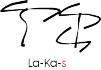
Using the Spanish kudlit, it would look like this with the S:
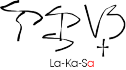
Besides the Spanish + kudlit, I’ve seen an X and backslash after the glyph used as illustrated below:

Another technique I’ve seen is a kudlit above and below the character as seen here. Interesting but can be confusing depending on the direction you write. The backslash kudlit is one of the many additions to the script championed by Bayani Mendoza de Leon. He released a great Baybayin manual full of instructions and history about the script. While it does cover basic Baybayin, a lot of it is his proposal of a modern script with new characters.
Baybayin: Ancient Script of the Philippines: A Concise Manual published by Bycynthium treasures
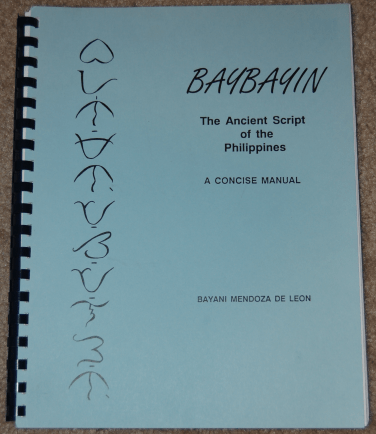
In addition to the backslash kudlit, the manual also goes into great detail on the O vs U & E vs I issue. This looks to resolve some of the guesswork that’s needed in order to read Baybayin.

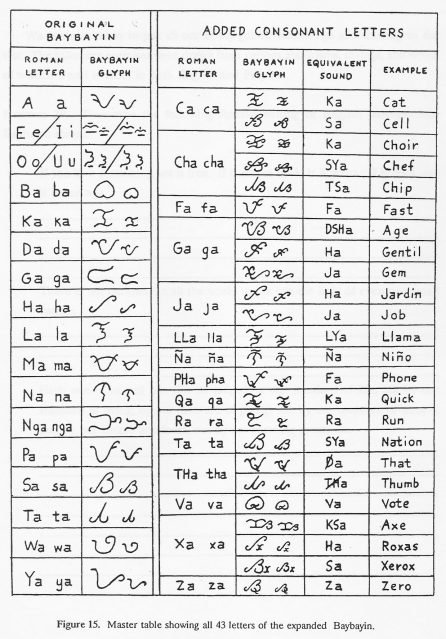
Also covered are consecutive similar vowels and consonants, silent consonants and added consonant letters. Below is a scan of the expanded Baybayin from page 46 of the manual.
Nordenx is also doing some interesting work on expanding Baybayin using hollow and solid kudlits to differentiate between E/I and O/U.
 Kristian Kabuay
Pingback: Baybayin Alibata translator | Baybayin.com
i want in baybayin the name Stavros ……i was find before the name of childs but now i dont find 😦 heeeeeeeeeeeeeeelp please
i want in baybayin the name Stavros ……i was find before the name of childs but now i dont find heeeeeeeeeeeeeeelp please
I used the kudlit above for the vowels ‘e’ and ‘i’ and ‘o’ and ‘u’,..in writing my journal…since in the beginning that I used BAYBAYIN…:
‘ . ‘ (small circle above the character) for ‘ i ‘
‘ — ‘ (horizontal bar above the character) for ‘ e ‘
‘ . ‘ (small circle below the character) for ‘ o ‘
‘ l ‘ (a vertical bar on the right of the character, actually the bar is half only of the character)
or ‘ _ ‘ (horizontal bar below the character) for ‘ u ‘
Sir can i ask po ano ang rules about da/ra? Same lang po talaga character? Or may way po to differentiate? Thanks po
tawa much>_<
laging masaya para hindi panget
ang puso ko mura lng naman pero nung nakilala kita biglang nagmahal;)))))))
nasan kaya ung hinahanap ko?????>.<
sana may pasok ngayon=))
sana makita ko na ung manunggul jar sa google?=))))
Hello sir ;
Can I request you to study about the spelling system in the baybayin script… what am I trying to say is… umm.. there is something about the missing consonant thingy… example: bundok is spelled as Bu+Do(buNdoK) -means mountain while Burol is spelled as Bu+Do(buroL) – means hill… the same spelling but different word… umm.. something about it… but if you dont want.. please email me whats the reason so I will stop thinking about it… 😀 thank you
You place a plus sign under the character to make the consonant letter. This is a Spanish modified baybayin. So for example. To make the character for “b”, use the spelling for “ba” which looks like an upside down heart then place a plus sign or cross sign under it and it will take out the “a” from it. Hope that makes sense.
Hi Vladimir,
Ancient Filipinos dropped the final consonant when writing as they do not have a character for just a consonant without a vowel sound. But the missing consonant is read and that’s how expert they are in writing and reading Baybayin. They may have some kind of technique in reading or it will just depend on the context to know if it is Budo (mountain) or Budo (hill) and other similar spelings. It’s just like how some of the English words today with same spelling but different meaning.
Um the ‘+’ sign
may tanong lang ako, papaano isulat and R at D parang hindi sya consistent base sa baybayin characters, sa ibang pahina wala ang R.
how can i write RA- RE- RI- RO- RU?
I have the same concern as Vladimir.
What would ‘Elise’ look like, sounds like ‘ehh-leese?’
Hi sir, i hope youre still monitoring this site. I want to learn baybayin and i want to learn the rules po. Im one of those few who thought we can just match the syllables of the characters with the tagalog syllables and thats it but ive read another blog that it doesnt work that way… Parang same po sa comment above about the word bundok ( ive encountered this example din before) and they drop the last letter.
Another example po, for the word “matanglawin”, may nabasa po ako they write the baybayin as “matanglawan” so i want to know whats the rule po ba to write the tagalog into baybayin.
Thanks so much po sir.
Another question po sir, how about the word “trabaho”, Ive read that it has to be separated yun 2 consonants po, should it be written as ta-ra-ba-ho? Or tra-ba-ho? which one is correct po? Thanks.
Hi guys, anyone here po? Trying to study baybayin.
Hello Po. Thank you. na kaka proud talaga. pero bakit walang characters for the numbers? Sana meron para sa future may complete keyboard na for Ancient Pilipino script na tayo sa phone.
Not sure if this will get a reply, but I have a question for a few words when transliterating to traditional. Using the words such as ang, aking, syang and at. When implementing the traditional system, (in order presented) would that be a, aki, sya (unsure about this translation), and a when writing the script?